


30x40 Posters: The Versatile Format for Pairs and Groups
A practical guide to the 30x40 cm poster format: how to hang pairs and trios with the right spacing, use 30x40 as a satellite on a gallery wall, and know when to step up a size.
Somewhere between the postcard-sized prints that vanish on a wall and the statement formats that demand a whole room sits a size that simply works. The 30x40 poster is that size. At 30 by 40 centimetres it is small enough to hang in pairs and trios, large enough to read clearly from across the room, and light enough to put up without drilling a single hole. Most size guides rush past it on the way to 50x70 and 70x100 — this one stops and gives the workhorse format the attention it has earned.
Because 30x40 rarely performs as a lone statement piece, the skill lies in grouping: a pair above a sideboard, a trio over the bed, a set of satellites orbiting a large anchor print on a gallery wall. This guide walks through the classic hangs, the exact measurements that make them look intentional, the hanging-height rule professionals rely on, and the honest moments when you should choose a bigger format instead.
Why 30x40 Is the Workhorse of Poster Formats
Poster sizes tend to be discussed as a ladder: 21x30 for shelves, 50x70 for the sofa wall, 70x100 for the statement moment. The 30x40 format sits on the rung most guides skip, and that in-between position is precisely its strength. It is large enough to carry a motif you can appreciate from the doorway, yet small enough that two or three of them fit comfortably where a single 50x70 would feel cramped.
The 3:4 proportion is calm and familiar — the same ratio as a classic photograph — and it works equally well hung portrait or landscape. Most importantly, 30x40 multiplies gracefully. A pair reads as a deliberate composition rather than two lonely prints; a trio establishes rhythm; four in a grid become a quiet architectural feature. If you are decorating the narrow wall slices real homes are full of — the gap between two windows, the strip above a radiator, a hallway run, the awkward wall at the top of the stairs — this is the format that fits without a fight.
The Classic Pair: Two 30x40 Posters Above a Sideboard
The two-print pair above a sideboard, console or chest of drawers is the most reliable hang in home décor, and 30x40 is its natural size. Framed, each print measures roughly 32 by 42 centimetres, so a pair hung side by side spans about 70 centimetres — a comfortable match for furniture between 100 and 160 centimetres wide. As a rule of thumb, the art should span roughly half to two-thirds of the width of the piece beneath it, which keeps the arrangement looking anchored rather than adrift.
- Hang the two frames 5-8 cm apart — close enough to read as one unit, far enough apart to breathe.
- Align the top edges precisely. A pair forgives many sins, but not a one-centimetre height difference.
- Keep the bottom edges 20-30 cm above the sideboard surface so lamps and vases have room underneath.
- Use identical frames and identical orientation — portrait suits most pairs best.
- Choose motifs from the same series or palette so the pair reads as a conversation, not a coincidence.
The Trio: Three in a Row Above the Bed or Sofa
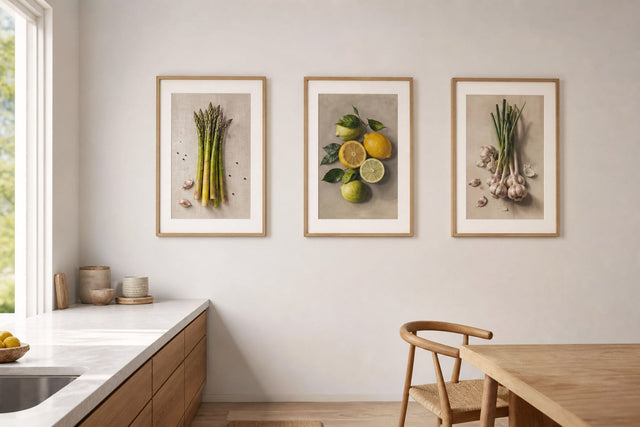
Three 30x40 prints in a horizontal row is the classic hang above a double bed, and it earns the role mathematically. With 5-8 centimetre gaps between frames, a framed trio spans roughly 105-110 centimetres, which sits beautifully centred above a 140 or 160 centimetre bed without stretching to the edges of the headboard. The same logic works above a two-seat sofa or a dining bench.
Keep the row strictly level, with bottom edges 15-25 centimetres above the headboard, and hold the spacing perfectly even — the eye detects an irregular gap in a trio instantly. Odd numbers read as intentional in a way even numbers rarely do, which is why the three-in-a-row hang feels composed even with very simple motifs. Think of the trio as a triptych: three botanical studies from the same series, three tones of the same abstract palette, or a left-centre-right progression where the visual weight settles gently in the middle.
The Satellite Role: 30x40 on a Gallery Wall
On a larger gallery wall, 30x40 plays its most sophisticated role: the satellite. A typical Scandinavian gallery wall is built around one anchor — usually a 50x70 or 70x100 print hung slightly off-centre — with smaller formats orbiting it. The 30x40 is the bridge size that steps the eye down from the anchor to the small 21x30 fillers; without it, a gallery wall tends to look like one big print surrounded by confetti.
Place two or three 30x40 prints on the open side of the anchor, keep every gutter in the arrangement a consistent 5-8 centimetres, and let the outer edges of the composition form a loose rectangle. Before a single nail goes in, test the whole arrangement to scale with the free Gallery Wall Builder — you can drag 30x40 groupings around a virtual wall, swap motifs in and out, and see exactly how the sizes balance before you commit.
The 145 cm Rule: Hanging at the Right Height
Galleries hang art so that the centre of the work sits at average eye height, and the number to remember at home is 145 centimetres from the floor to the centre of the artwork. For a single 30x40 print, that puts the nail surprisingly low — which is exactly why so much home art hangs too high.
For pairs, trios and gallery walls, treat the entire group as one artwork: measure to the centre of the whole block, not to each print. There are two sensible exceptions. Above furniture, the furniture wins — space the prints off the sideboard or headboard as described above and ignore the 145 rule. And along a staircase, the row of prints follows the diagonal of the steps, with each centre roughly 145 centimetres above the tread below it.
When to Step Up to 50x70 Instead
There are walls where 30x40 is the wrong answer, and it pays to recognise them before the parcel arrives. The clearest signal is width: once an unbroken wall section stretches wider than about two metres, even a pair of 30x40 prints begins to float in the emptiness. At that point, either expand the group substantially or move up a format.
- The wall section is wider than about 2 metres and your group would span less than half of it — step up to 50x70, or build around a 70x100 anchor.
- You view the wall mostly from more than three metres away, as in open-plan rooms — small formats lose their detail at that distance.
- The motif is dense — fine line art, city maps, detailed typography — and needs more surface area to stay legible.
- The furniture below is over 180 centimetres wide; a 30x40 pair above a full-width sideboard looks like an afterthought.
Shelf Styling and Rentals: The Low-Commitment Format
The quiet superpower of the 30x40 format is its weight, or rather the lack of it. A print on 200 gsm poster paper in a slim wooden frame is light enough for adhesive hooks and picture-hanging strips — welcome news in rental flats where every drill hole comes out of the deposit. It is also the largest format that leans reliably: on a picture ledge, a mantel or a deep shelf, a framed 30x40 stands stable on its own, and you can layer a smaller 21x30 print in front of it for an effortless, studio-styled look.
For anyone who rearranges rooms with the seasons, this flexibility matters more than any styling rule. A 30x40 trio can move from the bedroom to the hallway in ten minutes, a leaning print can be swapped the moment a new favourite arrives, and nothing needs patching or repainting when the lease ends. It is the format for people whose taste is still moving — which, honestly, is most of us.
Choosing Motifs That Work in Series
A group of 30x40 prints succeeds or fails on the relationship between the motifs. The reliable recipe is to keep the palette and the style constant while varying the subject — that is what makes a set feel curated rather than repetitive. A few pairings that consistently work:
- Black and white line art in a pair with oak or black frames — calm and graphic, safe above almost any sideboard.
- A botanical trio in greens and soft cream with white frames — the classic bedroom hang, gentle without being bland.
- Terracotta and beige abstracts with walnut frames — warmth for rooms with linen, rattan and wood tones.
- Blue-toned coastal or sky motifs in a trio with light frames — a natural fit for bathrooms and summer-house moods.
- One typographic print flanked by two pictorial ones — a simple trick that gives a trio a clear centre of gravity.
With more than 8,000 posters and art prints in the range — Scandinavian, botanical, abstract, vintage, city maps and more — building a matched set is mostly a matter of filtering by palette and holding your nerve. Matching wooden frames come in 14 colours and 13 sizes, so a pair or trio can share exactly the same frame, which does more for cohesion than any motif choice. If you are working toward a calm Nordic look, the Scandinavian living room collection is a natural place to start hunting for series that hang well together.
Frequently Asked Questions About 30x40 Posters
How high should I hang a 30x40 poster?
Aim for the centre of the print at about 145 centimetres from the floor, which is average eye height. If it hangs above furniture, ignore that rule and place the bottom edge 20-30 centimetres above the surface instead. For pairs and trios, measure to the centre of the whole group, not each print.
How far apart should two 30x40 posters be hung?
Leave 5-8 centimetres between the frames. Closer than that and the frames fight each other; wider and the pair stops reading as one composition. Whatever gap you choose, repeat it exactly everywhere in the arrangement.
What size frame do I need for a 30x40 poster?
A standard 30x40 centimetre frame fits without any trimming, and the outer dimensions land around 32 by 42 centimetres depending on the moulding. Buying all frames for a group in the same colour and profile is the single easiest way to make a set look intentional.
Is a 30x40 poster big enough for a living room wall?
On its own, only for narrow wall sections — think under a metre wide. On a full sofa wall, use 30x40 in a trio or as satellites around a 50x70 or 70x100 anchor. Once a wall section passes about two metres in width, a lone 30x40 will look lost.
What is 30x40 cm in inches?
Roughly 11.8 by 15.7 inches, which makes it the close European cousin of the US 12x16 format. Most frames sold as 12x16 will not fit a 30x40 print precisely, so stick to centimetre-sized frames for a clean fit.
Ready to put the workhorse to work? Start with a single pair, live with it for a week, and let the wall tell you whether it wants a third. With 100-day returns there is room to change your mind, and the bestsellers collection is full of motifs that have already proven they play well in pairs and groups.
Build your wall virtually before you spend a penny
Arrange sizes and layout on a virtual wall — free, before you buy.

Start with these
See the whole collection →


Related inspiration


100-day returns