


Bauhaus: The History Behind the Shapes and Its Legacy in Modern Wall Art
The Bauhaus school, founded by Walter Gropius in 1919, revolutionized modern design by merging fine art with craftsmanship. Its core philosophy, 'form follows function,' prioritized utility and simplicity, manifesting in iconic geometric shapes—circles, squares, and triangles—and primary colors. This movement laid the groundwork for contemporary minimalism and remains a pivotal influence in interior decor today.
When we look at the clean lines of modern furniture or the bold geometry of contemporary abstract art, we are looking at the echoes of a movement that began over a century ago. Bauhaus is not merely a style; it is an ideology that fundamentally shifted how the world perceives design, architecture, and art. At Posterlefi, we understand that hanging a Bauhaus print is not just a decorative choice—it is a nod to a revolutionary history that championed the union of art and technology.
What is Bauhaus? The Philosophy of Form and Function
Founded in Weimar, Germany, in 1919 by architect Walter Gropius, the Staatliches Bauhaus was born into a world recovering from the chaos of World War I. Gropius envisioned a utopian craft guild combining architecture, sculpture, and painting into a single creative expression. The defining mantra of the school was "form follows function." This meant that the aesthetic appearance of an object or building should be derived directly from its intended purpose, stripping away the excessive ornamentation of the Victorian era.
This philosophy gave rise to the minimalist art and design principles we cherish today. The curriculum at Bauhaus was rigorous, encouraging students to experiment with industrial materials like steel, glass, and concrete, while mastering the fundamental language of visual communication: color, texture, and shape. This historic pivot is why our vintage collection often features designs that look startlingly modern despite being created in the 1920s.
The Trinity of Shapes: Triangle, Square, Circle
One cannot discuss Bauhaus without addressing the obsession with elementary geometric forms. The masters of the school, including Wassily Kandinsky and Paul Klee, believed that shapes carried inherent emotional and psychological weight. This was not random geometry; it was a universal language.
- The Square: Often associated with the color red, the square represented logic, construction, and stability. It is the foundation of architecture.
- The Triangle: Frequently paired with yellow (or gold tones in modern interpretations), the triangle symbolized energy, dynamism, and thought.
- The Circle: Linked to the color blue, the circle represented spirit, fluidity, and infinity.
These shapes became the building blocks for what we now categorize as illustration & graphic art. In our curation at Posterlefi, we see these shapes re-emerging constantly. A simple composition of circles and lines can anchor a room, providing a focal point that is intellectual yet accessible.
The Evolution of the School: Weimar, Dessau, Berlin
The history of Bauhaus is also a history of migration and resilience. The school moved from Weimar to Dessau in 1925, where Gropius designed the iconic Bauhaus building—a manifesto of modernism in itself. In Dessau, the focus shifted more intensely toward industrial design and mass production. This era produced some of the most recognizable furniture and line art concepts.
Finally, the school moved to Berlin in 1932 under the leadership of Ludwig Mies van der Rohe, famous for the aphorism "Less is more." However, the rise of the Nazi regime, which deemed the movement "degenerate art," forced the school to close permanently in 1933. Paradoxically, this closure spread Bauhaus ideas globally. The masters and students emigrated to the United States, Switzerland, and Israel, influencing everything from New York skyscrapers to Scandinavian residential design.
Bauhaus and the Scandinavian Connection
Why do Scandinavian design lovers gravitate toward Bauhaus prints? The answer lies in shared values. Both movements prioritize functionality, simplicity, and a democratization of design. The Nordic aesthetic, characterized by light woods, white spaces, and cozy textures, provides the perfect canvas for the bold geometry of Bauhaus.
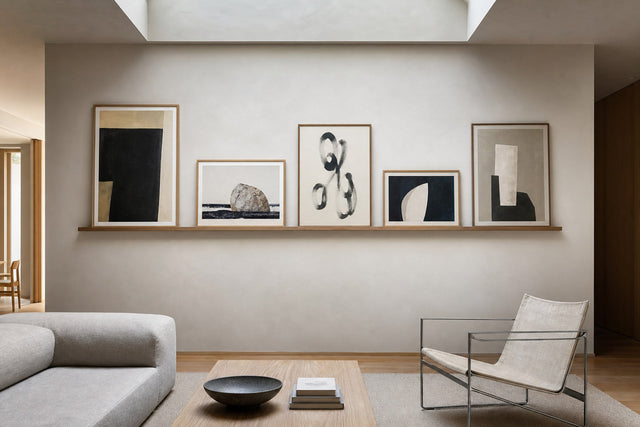
Integrating these historical prints into a Scandi-style home creates a sophisticated contrast. A monochromatic room dominated by gray and beige tones comes alive when punctuated by a classic Bauhaus exhibition poster featuring stark typography and geometric forms.
The Posterlefi Gallery Wall Method
At Posterlefi, we have analyzed thousands of interior setups to determine the best way to display geometric history. Here is our recommended approach for styling Bauhaus art:
- The Anchor Piece: Start with a large-format poster from our bestsellers that features the classic "Bauhaus Ausstellung 1923" motif. This sets the historical context.
- The Color Balance: If your room is neutral, introduce a print with a pop of orange or primary red to draw the eye. If your room is already colorful, opt for a strict black and white geometric composition.
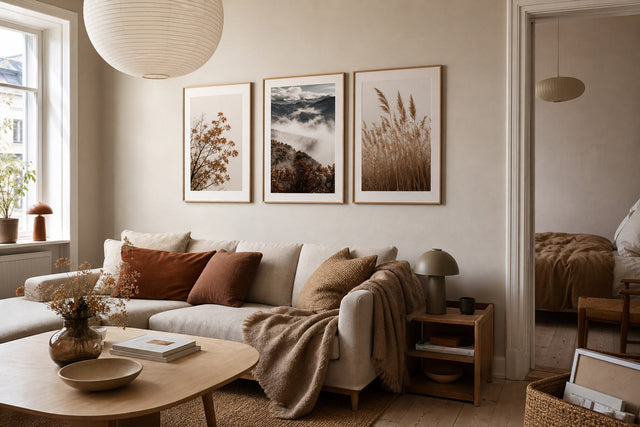
- The Mix: Don't be afraid to mix eras. A structured Bauhaus print looks incredible next to softer leaves & plants art or even nature photography. The organic shapes of nature soften the rigid geometry of the Bauhaus, creating a balanced, harmonious look.
- Grid vs. Organic: For Bauhaus prints, a grid layout (frames aligned perfectly) mimics the orderly nature of the movement. However, an organic arrangement can make the space feel more lived-in.
Comparative Analysis: Bauhaus vs. Art Deco
To truly appreciate the radical nature of Bauhaus, it is helpful to compare it with its contemporary, Art Deco.
| Feature | Bauhaus | Art Deco |
|---|---|---|
| Philosophy | Form follows function; social equality. | Decoration and luxury; glamour. |
| Materials | Steel, glass, concrete, plywood. | Exotic woods, jade, velvet, brass. |
| Shapes | Geometric, asymmetrical, abstract. | Symmetrical, sunbursts, zigzags. |
| Color Palette | Primary colors, Black, White, Gray. | Gold, Jewel tones, Pastel. |
| Best Pairing | Scandinavian interiors. | Maximalist or glamorous interiors. |
Key Entities in Bauhaus History
To deepen your understanding of the prints you display, it is essential to know the masters behind the shapes:
- Walter Gropius: The founder and architect who unified the disciplines.
- Wassily Kandinsky: The abstract painter who taught the psychological effects of color and form.
- Paul Klee: A master of color theory whose work often bridged the gap between paintings and graphic design.
- Laszlo Moholy-Nagy: A photographer and painter who embraced technology and industry.
- Josef Albers: Famous for his "Homage to the Square" series, exploring chromatic interactions.
Bringing History Home
Incorporating Bauhaus art into your home is not just about following a trend; it is about celebrating a century of modern thought. Whether you are an interior decorator looking for the perfect quote posters regarding design philosophy, or a homeowner wanting to add structural elegance to a living room, the Posterlefi collection offers a bridge to the past.
We recommend exploring our new in section regularly, as we frequently update our inventory with remastered classics that pay homage to the Weimar and Dessau eras. Remember, good design is timeless.
Frequently Asked Questions
Why is Bauhaus design still popular today?
Bauhaus remains popular because its principles of simplicity, functionality, and minimalism are timeless. It pairs perfectly with modern technology and contemporary architectural trends, particularly the open-plan living styles prevalent today.
Can I mix Bauhaus art with other styles?
Absolutely. Bauhaus prints act as a neutral geometric base. They pair exceptionally well with botanical prints for a nature-meets-industry vibe, or with photography for a modern gallery wall.
What are the main colors of Bauhaus?
The movement heavily favored the primary colors—Red, Blue, and Yellow—along with neutral tones like Black, White, and Gray. However, modern interpretations often include pink or green to adapt to contemporary interior palettes.
Who were the most famous Bauhaus artists?
The most renowned figures include Walter Gropius, Wassily Kandinsky, Paul Klee, Marcel Breuer, and Ludwig Mies van der Rohe.
Build your wall virtually before you spend a penny
Arrange sizes and layout on a virtual wall — free, before you buy.

Start with these
See the whole collection →


Related inspiration

100-day returns