


Affordable Posters: Style Your First Apartment on a Budget
A practical guide to decorating your first apartment with affordable posters: the budget sweet-spot formats, how to build a three-poster series that looks intentional, and renter-friendly ways to hang everything without losing your deposit.
Your first apartment rarely looks like the daydream. It is usually a compact rental with bright white walls, a strict deposit clause, and whatever budget is left after the deposit itself, a mattress, and a secondhand desk. Here is the encouraging part: walls are the cheapest square meters in the whole place to transform. A few well-chosen affordable posters will change the feel of a room more than any single piece of furniture can, and unlike furniture, every one of them moves with you when the lease ends.
This guide is written for exactly that moment: study start in a new city, small rooms, smaller budget. We will cover the two poster formats that give you the most wall for your money, why a matched three-poster series almost always looks more deliberate than one expensive statement piece, color palettes that flatter rental-white walls, and hanging methods your landlord will never notice. By the end, you should have a plan for a wall you actually love instead of a wall you merely filled.
Why several small posters beat one big statement piece
When money is tight, the instinct is to save for one large, impressive artwork. Resist it. A single 70x100 cm piece concentrates all of your budget, and all of your risk, in one spot. If it clashes with your bedding or disappears against the afternoon light, the whole room misses with it.
Several smaller prints spread the risk. They fill more sightlines, so the room feels decorated from the door, from the desk, and from the bed, not just from one angle. They are also flexible: the trio above your sofa this year can split up next year, one print to the hallway, two above a new desk. A series also creates rhythm and repetition, which is what makes a wall read as curated rather than random. And smaller posters travel flat in a folder, survive the bike ride home, and rehang in minutes when you move.
The budget sweet spot: 30x40 and 50x70 cm
Two formats do most of the work in a first apartment: 30x40 cm and 50x70 cm. Both are common European standard sizes, which keeps framing simple now and leaves you the widest choice later. Here is how the usual formats actually behave on a wall:
- 21x30 cm - postcard-plus territory. Charming in groups of four or more, or propped on a shelf, but too small to hang alone above furniture.
- 30x40 cm - the workhorse. Large enough to read across a room, small enough to cluster. Three in a row with 6 cm gaps span roughly 112 cm, which sits beautifully above a desk or a chest of drawers.
- 50x70 cm - the anchor. One above a bed or sofa holds its own, and a row of three spans about 180 cm, enough to carry the main wall of a living room.
- 70x100 cm - genuine statement size. Skip it in a first flat unless you have one large, truly empty wall that demands it.
One rule to remember: 30x40 for grids, pairs, and desk walls; 50x70 for the one or two walls that need real presence. Nearly every layout in this article is built from those two sizes.
How to build a three-poster series that looks intentional
Three is the magic number of budget wall decor. A trio reads as a decision; two prints can look like leftovers, and five strains both the wallet and the wall. The catch: the prints must clearly belong together, through a shared palette, a shared subject, or a shared style. Aim for at least two of the three.
A few reliable recipes to start from:
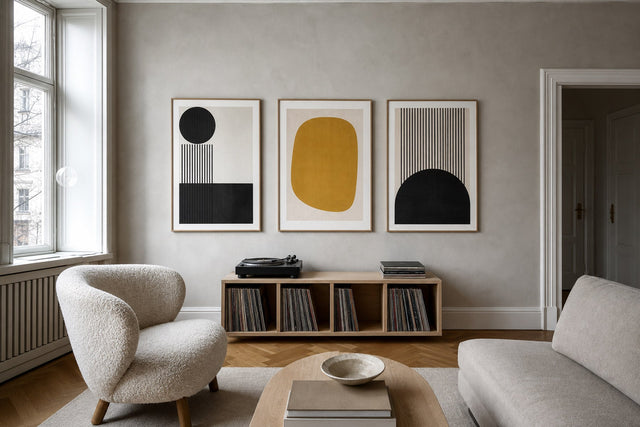
- The line-art trio - three black and white line drawings in 30x40 cm, identical black or oak frames, hung in a row with 5-7 cm between frames. Graphic, calm, and nearly impossible to get wrong.
- The botanical gradient - three botanical prints moving from pale sage to deep forest green, in matching oak frames. Quietly lovely above a bed.
- The city set - map or city posters of your hometown, your study city, and the place you dream of living next. A series with a story built in.
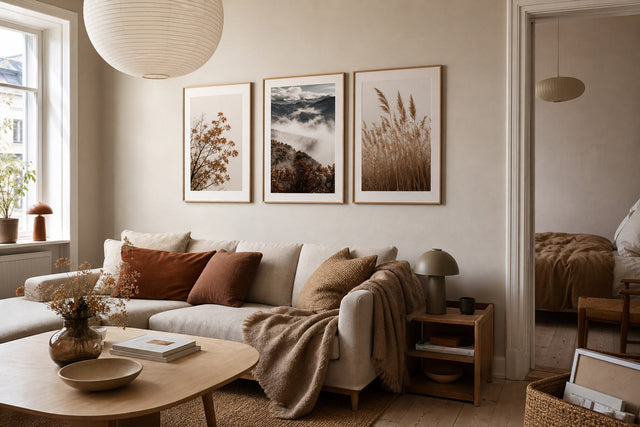
- The tonal abstracts - three abstract prints in beige, terracotta, and rust. Warm, grown-up, and very forgiving of mismatched secondhand furniture.
Hang the series so the vertical center of the row sits around 145-150 cm from the floor, keep the gaps identical, and use the same frame on all three. Consistent frames and spacing are what make an inexpensive series look considered. With more than 8,000 posters and art prints to mix, from Scandinavian minimalism to vintage, botanical, and black and white styles, you can browse the full poster collection until three of them click together.
Color palettes that flatter rental-white walls
Rental white is not a problem to solve; it is a free gallery wall, and almost every palette works against it. Some combinations are especially kind to first apartments, though.
Warm neutrals - beige, sand, and terracotta prints in oak frames - take the clinical edge off white paint and pair naturally with wooden furniture, rattan, and linen. Monochrome - black and white photography or line art in slim black frames - gives a sharp, graphic look that matches any bedding you own now or buy later. Muted pastels - sage, dusty blue, and blush in white frames - blend softly into the wall for a calm, airy room that feels bigger than it is. And if your taste runs bolder, pick one accent color, perhaps mustard or deep blue, and let it repeat across all three prints so the wall reads as a theme rather than a coincidence.
The simplest method of all: pull two colors from things you already own, your duvet cover, a rug, a thrifted chair, and choose posters that repeat them. The room instantly looks planned, even if the plan took ten minutes.
Hang it all without losing your deposit
Renter-friendly hanging is a solved problem. You just need to match the method to the weight of what you are hanging:
- Adhesive picture strips - hold a framed 30x40 or 50x70 when you respect the weight rating on the pack. Press firmly for 30 seconds; remove later by stretching the tab straight down so the paint stays on the wall.
- Washi tape - for unframed posters, tape the four corners or just the top edge. It peels off cleanly and doubles as a design element in a casual grid of 21x30 or 30x40 prints.
- Poster hangers on an adhesive hook - a slim wooden rail grips the top edge of the poster and hangs from one small removable hook. Swapping the print takes ten seconds.
- Lean instead of hang - a framed 50x70 resting on a desk, a shelf, or the floor against the wall looks deliberately relaxed and requires no hardware at all.
- Use the holes you inherited - most rentals already have a nail or two from the previous tenant. Sketch your layout around them before you add anything new.
Unframed posters on 200 gsm or 230 gsm poster paper weigh next to nothing, so tape and rails handle them easily. Add a wooden frame and the math changes: check the rating on your strips or hooks first.
Room-by-room ideas for a studio or dorm
The bed wall is the natural anchor. A single 50x70, or a pair, centered above the headboard with the lower edge 15-25 cm above it, makes the bed look like a piece of furniture you chose rather than one you were issued. Calm subjects work best where you sleep: botanicals, soft abstracts, hazy landscapes.
The desk wall rewards restraint. A row of three 30x40 prints in muted tones or simple line art gives your eyes somewhere to rest between paragraphs without competing with the screen. Save the loud graphic prints for elsewhere.
The kitchenette needs exactly one thing: a single 30x40 food, coffee, or botanical print, washi-taped or leaning on a shelf, to signal that this corner was decorated on purpose.
If you live in one room, use posters to zone it. One series above the bed and a different one above the desk splits a studio into sleeping and working zones, no room divider required. Keep both series in the same frame color so the room still hangs together.
Frames now, frames later
Matching frames are the single biggest reason a wall of cheap wall art reads as expensive. They add straight lines, shadow, and unity, and they make three unrelated prints look like a set. But you do not need everything framed on day one, and pretending otherwise is how budgets break in August.
A sensible sequence: hang your posters unframed with washi tape at semester start, live with them for a month, then frame the keepers one at a time. Posterlefi's wooden frames come in 14 colors and 13 sizes, so the frame can arrive months after the poster and still match. If a favorite earns permanent status, a canvas print is a further upgrade path.
Plan the wall before you buy anything
The most expensive mistake in budget decorating is buying blind: prints too small for the wall (the most common first-apartment error), styles that duplicate each other, or a layout that never resolves. The free Gallery Wall Builder lets you arrange sizes and layouts on a virtual wall before checkout, so you can test a row of three 50x70s against a 2x2 grid of 30x40s and see which one your living room actually needs.
The remaining risk is handled by policy rather than planning. Shipping is free on orders over 399 kr in Denmark and over 49 EUR in the rest of the EU, with worldwide delivery if your study year takes you further, and every order comes with 100-day returns. If a print reads differently in your room's light than it did on screen, you have more than three months to send it back and try another.
FAQ: affordable posters for a first apartment
What size posters are best for a small apartment? Stick to 30x40 cm and 50x70 cm. The smaller size works in rows and grids above desks and dressers, while 50x70 is large enough to anchor a bed or sofa wall without overwhelming a compact room. Save 70x100 cm for a large, genuinely empty wall.
How do I hang posters without damaging rental walls? Use adhesive picture strips for framed prints, washi tape or poster rails for unframed ones, and lean larger framed pieces on shelves or the floor. All of these remove cleanly and keep your deposit intact.
How many posters do I need to make a wall look finished? Three is the most reliable number. A trio with a shared palette or subject, matching frames, and even spacing reads as intentional, while a single small print can look stranded on a large wall. Start with three and add later if the wall still feels sparse.
Are affordable posters worth framing? Yes, and the frame does more work than you might think. A matched set of frames adds structure and makes budget prints look like a curated collection. You can phase the cost by hanging posters with washi tape first and framing your favorites one at a time.
How high should posters be hung? Aim for the center of the artwork, or of the group, at roughly 145-150 cm from the floor, which is average eye level. Above furniture, keep the lower edge 15-25 cm above the headboard or sofa back so the pieces read as connected rather than floating.
Bare white walls are not a limitation; they are the best blank canvas you will ever rent. Start with two sizes, one palette, and a three-print series, and the room will feel like yours by the weekend. If you want a proven starting point, browse the bestselling posters and see which three belong together on your wall.
Build your wall virtually before you spend a penny
Arrange sizes and layout on a virtual wall — free, before you buy.

Start with these
See the whole collection →


Related inspiration
100-day returns