


Winter Wall Art: Get Your Walls Ready for the Cold Season
Swap your autumn prints for winter wall art without buying a single new frame. Standard sizes make the seasonal switch a two-minute job, and this guide covers the motifs, palettes, and layouts that carry a room from November to March.
There is a point every year, usually somewhere between late October and mid-November, when the rust, amber, and burnt-orange prints that felt so right in September start to look tired. The light outside has changed: it is cooler, bluer, and lower in the sky, and walls still dressed for autumn no longer match what is happening beyond the window. That quiet mismatch is the signal that it is time to bring in winter wall art — and the good news is that the switch takes far less effort than most people assume.
You do not need new frames, new hooks, or a free weekend. If your prints hang in standard sizes, swapping autumn for winter is a matter of opening the frame backs, sliding one print out and another in, and rehanging everything exactly where it was. In this guide we will walk through how to make the swap in minutes, which motifs actually read as winter rather than just generic cold, how to build a blue-and-white palette that does not feel icy, and how to store your autumn prints so they come back in perfect condition next year.
Why Swap Prints Instead of Redecorating
When a room feels out of step with the season, the instinct is often to reach for big solutions: new cushions, new throws, sometimes even a new paint color. All of that works, but it is slow, and most of it is expensive to repeat twice a year. Art is different. A print swap changes the largest visual surfaces in the room — the walls — in a fraction of the time, and the pieces you take down are not gone, only resting until next October.
There is also a perception argument for rotation. After a few months, you stop seeing the art on your own walls; your eye simply files it under furniture. Changing the prints with the season resets that. The frames, the layout, and the hooks all stay put, yet the room reads as freshly decorated. It is the highest return on effort in home décor.
The Two-Minute Swap: Keep the Frames, Change the Print
The whole trick rests on standard sizing. Poster sizes such as 30×40 cm, 50×70 cm, and 70×100 cm are consistent from print to print, so a winter landscape slides into the exact frame your autumn botanical just left. Posterlefi frames come in 14 colors and 13 sizes, so one well-chosen frame per spot can serve every season. The prints themselves are on 200 gsm or 230 gsm paper — stiff enough to sit flat in the frame and to survive years of seasonal handling.
Here is the swap routine that keeps everything safe and takes about two minutes per frame:
- Photograph the wall first. A quick phone photo of your autumn arrangement means you can rebuild it identically in spring without measuring anything.
- Work face-down on a soft surface. Lay the frame on a towel or blanket before opening the backing tabs, so the glass and frame corners are protected.
- Match size to size. Replace a 50×70 cm print with another 50×70 cm print. No trimming, no new mounts, no guesswork.
- Wipe the inside of the glass. A dry microfiber cloth removes dust before the new print goes in — the one moment you can reach that surface.
- Handle prints by the edges. Fingerprints in the middle of a matte print are hard to remove; edge-handling avoids them entirely.
Do this for four or five frames and the entire room has changed season before your coffee goes cold.
What Actually Reads as Winter on a Wall
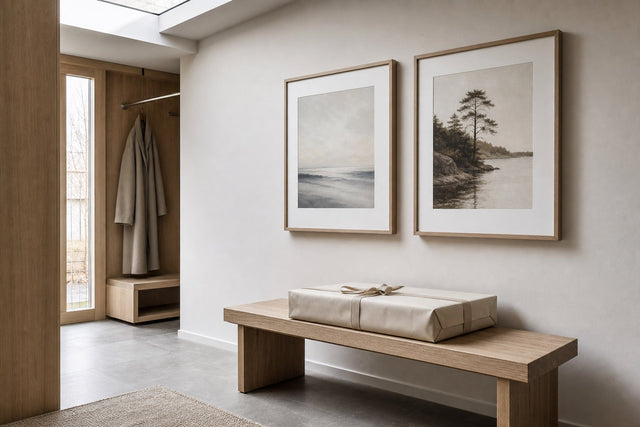
Not every cool-toned print says winter. The motifs that carry the season most convincingly are borrowed from the Nordic landscape itself: snow-covered pine forests, birch trunks against white ground, mountains under low cloud, frozen lakes, and coastlines in fog. Snowy landscape prints work because they capture something specific about winter light — a low sun, long blue shadows, and a sky that is more pale gray than blue. If you want a starting point, browse landscape prints and filter your eye for exactly that quality of light.
Black and white photography is the other reliable winter performer. Bare trees, still water, and misty fields already look halfway to monochrome in the winter months, so black and white prints feel naturally at home from November through March. Minimalist line art and quiet abstract pieces in cool tones round out a winter wall without making it literal.
One deliberate choice worth making: skip overtly festive motifs if you want the wall to last the whole season. A snowy forest looks right from early November until the first buds of March. A holiday-specific print looks right for about four weeks. Seasonal wall art earns its keep when it covers the season, not just the celebration.
The Winter Palette: Cool Blues, Soft Whites, One Warm Accent
The classic Nordic winter palette is built from ice blue, slate, pale gray, charcoal, and warm white. It photographs beautifully, but on a real wall it needs one safeguard: a single warm accent. A room done entirely in blue and white can tip from calm into cold, especially under winter's gray daylight. The fix is to keep one small piece from your autumn rotation — an ochre abstract, a terracotta-toned botanical, a warm-beige line drawing — and let it sit inside the cooler arrangement like an ember.
Some pairings that consistently work:
- Ice blue + warm white + oak frames — the classic Nordic winter look; the pale wood does half the warming work for you.
- Charcoal + snow white + one ochre accent — graphic and modern, with the accent print keeping the wall from feeling stark.
- Slate blue + silver gray + black frames — moodier and more dramatic; suits rooms with good lamplight.
- Pale gray + muted evergreen + walnut frames — a softer take that nods to the forest without a single snowflake in sight.
If your walls are white, lean into tone-on-tone: white and off-white prints with subtle texture and shadow read as sophisticated rather than empty, and they make any accent color glow.
Sizes and Layouts That Make Seasonal Rotation Easy
Because the frames stay on the wall, your layout is already decided — you are only changing content. That is why it pays to standardize on a few sizes, so every future season has plenty of candidates to slide in. These formats cover almost every situation:
- Above a sofa: one 70×100 cm statement print, or two 50×70 cm prints side by side with a 5–7 cm gap, lower edge about 20–25 cm above the backrest.
- Over a sideboard or console: a row of three 50×70 cm prints with even spacing reads calm and intentional.
- Hallways and narrow walls: a vertical column of two or three 30×40 cm prints fits where nothing else does.
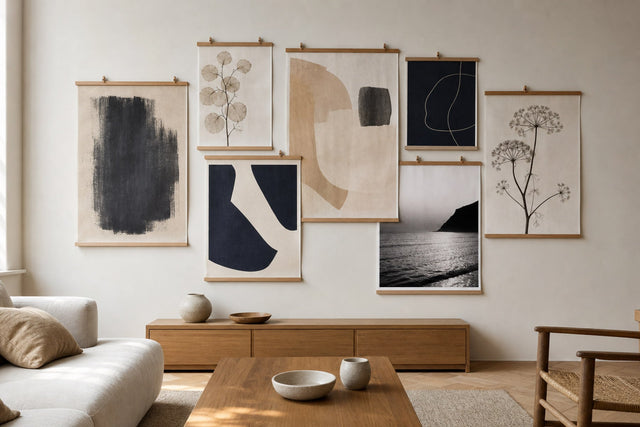
- Gallery walls: mix 21×30, 30×40, and 50×70 cm, keep the gaps consistent at 5–7 cm, and aim for the visual center of the group at 145–150 cm from the floor.
- Shelves and mantels: a leaned 30×40 cm frame can be swapped in seconds and is the easiest place to trial a new winter motif.
Stick to this size vocabulary and the autumn-to-winter swap never involves a hammer.
Room by Room: Where Winter Art Works Hardest
In the living room, go for the strongest statement — this is where winter evenings actually happen. A large snowy landscape or a pair of cool-toned prints above the sofa anchors the whole season, and warm lamplight in the evening plays beautifully against blue-and-white art.
In the bedroom, choose the quietest pieces you own: fog, soft snowfall, muted black and white. High-contrast graphics feel energetic, which is exactly what a bedroom in December does not need. In the hallway or entry, one confident winter print sets the season the moment anyone walks in. And in a home office, consider a bright, high-key snow scene; on dark afternoons, a print full of white light genuinely lifts the room.
How to Store Autumn Prints So They Come Back Perfect
The swap only works long-term if last season's prints survive storage. Store them flat rather than rolled whenever possible — a flat print goes straight back into a frame next year, while a rolled one needs days under books. Slip sheets of acid-free paper between prints, or keep them in the flat mailer they arrived in, and store the stack horizontally in a cool, dry place inside the living area of your home. Attics and basements swing too much in temperature and humidity.
Two small habits pay off in October: write the size lightly in pencil on the back of each print, and keep that phone photo of the wall arrangement in an album. Next autumn, the reverse swap takes exactly as long as this one did.
Plan the Whole Winter Wall Before You Buy
If you are changing more than one or two prints, it is worth seeing the winter versions together before ordering. The free Gallery Wall Builder lets you arrange prints in your exact frame sizes on a virtual wall, so you can test whether the blue-and-white balance holds, whether your one warm accent sits in the right spot, and whether that 70×100 cm landscape carries the room the way you hope. It turns the seasonal refresh from a guess into a plan.
And because Posterlefi carries more than 8,000 posters and art prints across Scandinavian, botanical, minimalist, abstract, and photographic styles, finding winter candidates in the sizes you already own is the easy part. With 100-day returns, a print that reads differently on your wall than on screen is easy to change.
Frequently Asked Questions
When should I switch to winter wall art?
Early to mid-November is the sweet spot. The autumn palette starts to feel out of step once the leaves are down and the light turns blue-gray, and swapping before December means your winter wall lasts the full season instead of arriving with the holidays and leaving with them.
Do I need new frames for winter posters?
No — this is the whole point of the seasonal swap. As long as you buy winter prints in the same standard sizes as your current ones, such as 30×40, 50×70, or 70×100 cm, they slide into the frames already hanging on your wall in about two minutes each.
How do I keep blue and white winter decor from feeling cold?
Keep one warm element in the arrangement: a single ochre or terracotta-toned print, or frames in oak or walnut rather than white or black. Warm lamplight in the evening does the rest. The goal is a wall that reads crisp and calm, not chilly.
What size winter print works best above a sofa?
A single 70×100 cm print is the simplest strong choice, hung with its lower edge 20–25 cm above the backrest. Two 50×70 cm prints side by side with a 5–7 cm gap give a similar presence and let you pair a snowy landscape with a quieter abstract.
How should I store posters between seasons?
Flat, in a cool and dry spot inside your living space, with acid-free paper or the original flat packaging between prints. Avoid attics and basements, handle prints by the edges, and pencil the size on the back so next year's swap is sorted in seconds.
When you are ready to make the switch, browse the full range of winter prints — snowy landscapes, Nordic light, and quiet blue-and-white scenes in every standard size — and give your walls a season's worth of calm in an afternoon.
Build your wall virtually before you spend a penny
Arrange sizes and layout on a virtual wall — free, before you buy.

Start with these
See the whole collection →


Related inspiration
100-day returns