


The Art of Hygge: Crafting Your Perfect Gallery Wall
Create a warm, balanced Hygge gallery wall with practical guidance on choosing art, frames, spacing and layouts for every room.
The Art of Hygge: Crafting Your Perfect Gallery Wall
In the heart of a Nordic home lies an appreciation for warmth, comfort and personal expression. A thoughtfully curated gallery wall brings those qualities together, transforming an empty surface into a visual story about the people, places and ideas that matter to you. More than a collection of framed pictures, a Hygge-inspired gallery wall can create calm, character and a natural focal point without making the room feel busy. The goal is not perfection. It is a balanced, lived-in composition that feels connected to the rest of your home.
What is a gallery wall, the Nordic way?
A gallery wall is an intentional arrangement of several artworks, photographs or meaningful objects on one wall. The Nordic approach favours clarity, natural materials and breathing space. Instead of filling every gap, it uses rhythm and restraint. A personal mix might include abstract prints, botanical illustrations, line art, family photographs and a small textile. Each piece should contribute something to the whole while still being interesting on its own.
The most convincing arrangements usually share one or two visual connections. Those connections can come from colour, subject, frame material or the amount of white space around each image. A varied group can therefore feel coherent without becoming uniform. This is central to Hygge: comfort grows from harmony, authenticity and details chosen with care.
Plan your Hygge gallery wall before hanging
Good planning makes the final wall feel effortless. Begin by deciding what the arrangement should express. It may celebrate nature, collect memories from favourite places or combine calm neutrals with one vivid accent. A clear direction makes it easier to choose art and prevents the composition from becoming visually noisy.
- Define a story: Write one sentence that describes the mood you want, such as “quiet coastal light” or “warm geometric energy”. Use it as a filter when choosing each piece.
- Choose an anchor: Start with one larger artwork or the image with the strongest visual weight. The remaining pieces can support it through colour, line or subject.
- Test the layout: Arrange the works on the floor before making holes. Move them until the outer shape feels balanced. Paper templates taped to the wall are useful for checking scale and height.
- Keep breathing space: Consistent gaps help different artworks feel related. Around 5–10 centimetres often works well, but a compact group may need less and a large wall may need more.
Choose frames that support the art
Frames should create structure without competing with the images. Light oak and other natural woods bring warmth, while black frames add definition and white frames feel quiet and airy. A single frame finish creates a calm, ordered result. Mixing two or three finishes can feel more personal, provided one material or colour is repeated across the wall.
Consider the room as part of the composition. Echoing the wood tone of a table, shelf or floor can make the gallery feel integrated. In a room with many colours, a restrained frame palette gives the eye somewhere to rest. In a neutral room, one darker frame can create a useful visual anchor.
Curate art with contrast and connection
A strong gallery wall combines similarity with contrast. Mix portrait and landscape formats, detailed and simple motifs, and larger calm areas with smaller expressive works. Repeating one colour in several pieces creates connection, while a different texture or shape keeps the wall alive. If every image has the same visual weight, the arrangement can feel flat; if every image demands attention, it can feel chaotic.
Lay the collection out and remove one piece at a time. If the wall becomes calmer without it, leave it out. A smaller, confident selection is often more effective than a larger group chosen only to fill space. Browse our latest posters when you want to introduce a new motif while keeping the overall palette in mind.
Arrange and hang with confidence
Start with the anchor piece and work outwards. For a living room, the visual centre of the group should usually relate to the furniture below it rather than to the full height of the wall. Above a sofa or sideboard, leave enough air that the gallery feels connected to the furniture but not crowded against it. Use a level and measure twice before fixing heavier frames.
- Symmetrical grid: Best for identical frame sizes and a calm, architectural expression.
- Organic cluster: Useful for mixed formats and a more relaxed, collected look.
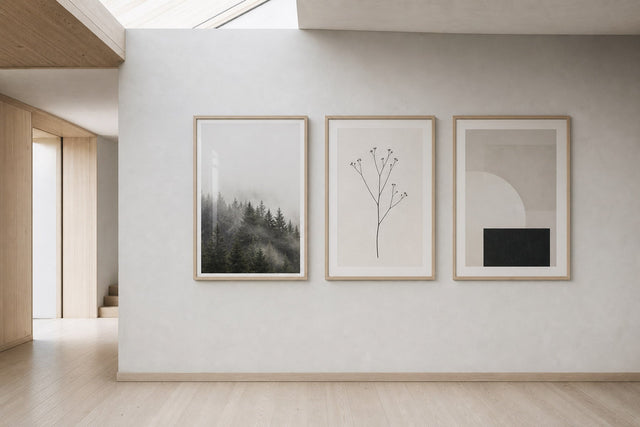
- Horizontal line: Creates order above a long sofa, bench or dining table.
- Vertical composition: Makes good use of a narrow wall, stair landing or space between windows.
Step back frequently while hanging. A few millimetres rarely matter on their own, but the overall rhythm does. Photographing the layout on your phone can also reveal imbalances that are difficult to notice when standing close to the wall.
Gallery wall ideas for different rooms
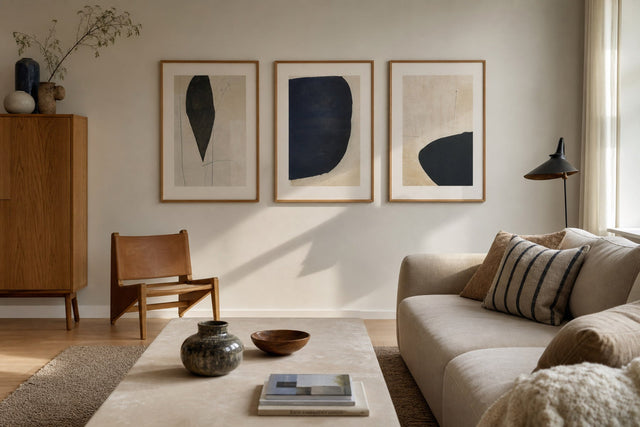
Living room: Build the arrangement around one expressive work and add supporting prints in quieter colours. Relate the width of the gallery to the sofa or sideboard beneath it so the two elements read as one composition.
Bedroom: Choose softer contrasts and motifs that invite rest. A small group above a chest of drawers can feel calmer than a large display directly over the bed. Natural frames and generous spacing reinforce the relaxed atmosphere.
Hallway: A narrow passage is ideal for a linear arrangement or a sequence of smaller works. Keep projecting objects to a minimum and use consistent frame depths so the route remains comfortable.
Dining area: Art can add warmth without taking up floor space. Use colours that complement the table, chairs and textiles, and place detailed pieces where they can be enjoyed at close range.
Common mistakes to avoid
- Hanging the group too high: Treat the collection as one artwork and relate its centre to normal eye level and nearby furniture.
- Using every favourite at once: Save some pieces for later. Editing gives the strongest works more impact.
- Ignoring scale: A tiny cluster can disappear on a wide wall, while an oversized group can overwhelm a narrow room.
- Adding too many frame finishes: Variety works best when at least one finish, colour or profile repeats.
- Forgetting the light: Check reflections and direct sunlight before choosing the final position.
Let the gallery evolve with your home
A Hygge home changes with the people who live in it, and a gallery wall can do the same. Replace one print when the seasons change, add an artwork connected to a new memory, or move a familiar piece into a different room. Small adjustments keep the arrangement personal without requiring a complete redesign.
Keep a simple record of frame sizes and take a photograph before making changes. That makes it easier to return to an earlier layout or test a new piece. Our gallery wall inspiration offers more examples of how different formats, colours and frame styles can work together.
A practical checklist
- Choose a mood, palette or story.
- Select one anchor artwork.
- Balance portrait, landscape and square formats.
- Limit the frame palette and repeat key materials.
- Test the full arrangement on the floor or with paper templates.
- Check height, light and spacing from across the room.
- Hang securely and leave room for the collection to evolve.
Bring Hygge into your home
A carefully planned gallery wall is more than decoration. It is a way to make a room feel personal, welcoming and complete. By combining meaningful art, natural materials, balanced spacing and a clear visual story, you can create a wall that feels calm today and still has room to grow tomorrow. Take your time, edit with confidence and let the final composition reflect the life you are building around it.
Build your wall virtually before you spend a penny
Arrange sizes and layout on a virtual wall — free, before you buy.

Start with these
See the whole collection →


Related inspiration
100-day returns