


Posters for the Summer House: Cabin Wall Decor Ideas
A practical guide to summer house wall decor: coastal and nature motifs that echo the landscape outside, relaxed salon-style hangs, and print sizes that suit low cabin ceilings.
Walk into almost any holiday home and you will find the same pattern: furniture that was chosen with care, a kitchen that works hard all of July, and walls that nobody has thought about since the keys were handed over. Summer house wall decor tends to be whatever was left over from the city — a faded print inherited from the previous owner, a calendar page in a clip frame, or simply nothing at all. The walls are the most neglected surface in the whole house, and they are also the easiest one to transform.
The encouraging part is that a summer house asks less of you than a city apartment does. Nobody expects perfection in a cabin, and that freedom is exactly what makes decorating one enjoyable. The walls can be looser, warmer and more personal — a collection that grows summer by summer instead of a scheme executed in one weekend. This guide covers how to choose motifs that echo the landscape outside your windows, why a relaxed salon-style hang suits a cabin better than a strict grid, which sizes work under low ceilings, and how to carry the holiday feeling back to town when August ends.
Let the walls echo what is outside the window
The most useful principle in holiday home decor is simple: do not compete with the view — continue it. In a city apartment, art often works as an escape hatch, a sea view for someone who lives above a car park. In a summer house, the landscape is already the main event, so the strongest choice is art that picks up the same thread. If you look out at dunes and water, lean into coastal posters: soft horizons, bathing jetties, abstract washes of blue. If the house sits among fields, botanical studies and wildflower illustrations feel instantly at home. If you are surrounded by forest, pine silhouettes, morning mist and moss-toned photography carry the mood indoors.
This echo does two things at once. It makes the house feel rooted in its place rather than furnished with leftovers, and it blurs the line between inside and outside — which is the whole point of a summer house. On a rainy day, and there will be rainy days, the walls keep the landscape present. When you browse nature prints, think of the motifs as postcards of what you can already see from the deck.
A palette borrowed from the coast, the meadow and the forest
Holiday homes flatter sun-bleached, slightly faded colour far more than saturated gallery colour. Think of how driftwood, straw and old jetty planks look after a few seasons outdoors — that softness is the register to aim for. A helpful exercise: stand at the window, name the five colours you actually see, and let those govern the walls.
- Coastal: sand, chalk white, faded denim blue and driftwood grey — calm together, and forgiving alongside white-painted panelling.
- Meadow: straw yellow, soft grass green and warm cream, with a single poppy-red accent print to wake the wall up.
- Forest: pine green, bark brown and mushroom beige, grounded by one or two black and white photographs.
- All-round cabin mix: warm white, ochre and muted blue — a combination that works whether the house faces water, fields or trees.
Choose one family and stay loose within it. The goal is not matching; it is a group of prints that clearly belong to the same summer.
Why a relaxed salon-style hang suits a cabin
A strict grid of identical frames looks wonderful in a high-ceilinged city flat and slightly absurd in a cabin. Holiday homes are rarely built for symmetry: ceilings slope, walls are panelled, beams interrupt, and the windows sit wherever the builder decided in 1974. A salon-style hang — mixed sizes, mixed motifs, hung close together in an organic cluster — embraces those quirks instead of fighting them.
Salon walls are also forgiving in a way grids are not. If you add a print next summer, the wall simply grows; nothing needs re-spacing. Start with one anchor piece, keep 5-8 cm between frames, and build outward while keeping the visual midpoint of the cluster near eye height. If you would rather not learn this by drilling holes in the panelling, plan the arrangement in the free Gallery Wall Builder first and hang the whole wall in one calm afternoon.
Four layout patterns that work on cabin walls
These patterns cover most cabin walls, from the hallway to the stairwell — pick the one that fits the surface you have:
- The anchored cluster: one 50x70 cm print with three or four smaller pieces (30x40 and 21x30 cm) drifting around it — the classic salon starting point.
- The horizon line: three to five prints in a row with their centres aligned at the same height, which visually calms a room with a sloped ceiling.
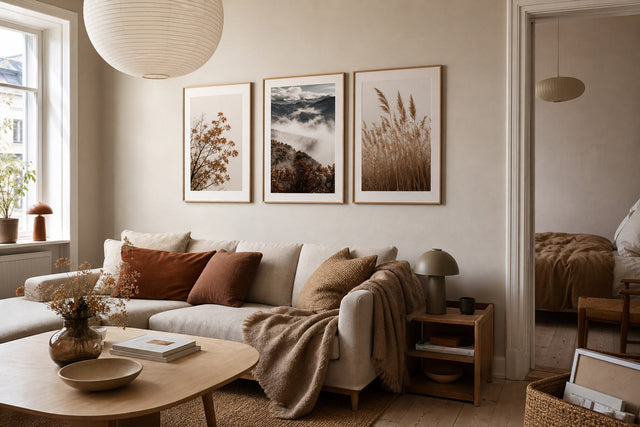
- The sofa spread: a pair or trio of 40x50 or 50x70 cm prints above the sofa, hung 15-20 cm above the backrest so the group reads as part of the seating area.
- The staircase drift: small prints (21x30 and 30x40 cm) stepping up the stair wall, each centre roughly following the angle of the handrail.
Whatever the pattern, keep the spacing between frames consistent. Even gaps are what make a loose arrangement look intentional rather than accidental.
Low ceilings? Think in pairs of 50x70
Many summer houses have ceilings around 220-230 cm, and this changes the size logic completely. A single 70x100 cm print hung vertically can overwhelm a low room, leaving almost no wall above or below it. The elegant answer is a pair of 50x70 cm prints hung side by side with a 5-7 cm gap. You get the presence of a large statement piece, but the emphasis runs horizontally — and horizontal emphasis makes a low room feel wider and calmer.
Hang pairs a touch lower than you would in the city: aim for a centre height of about 140 cm rather than the gallery-standard 145-150 cm, or simply relate them to the furniture below. Pairs are also the easiest purchase to get right — two motifs from the same series, or one landscape photograph and one abstract in the same blue, will always sit comfortably together. For smaller walls, the same trick works with two 40x50 cm prints.
Room by room: where the art should go
The entry sets the tone, and in a holiday home the tone should be light: one cheerful 40x50 cm motif is enough to say the holiday has started. The living room takes the main event — the salon wall — usually on the largest unbroken surface, often behind the sofa or facing it. Bedrooms want calm: a single 50x70 cm print above the headboard, in the quietest colours of your palette, does more than a busy cluster ever could.
Bunk rooms and kids' rooms are the place for playfulness — a few 21x30 cm prints of boats, animals or bold shapes, hung low enough for children to actually see them. In the kitchen, small botanical prints on a free shelf or between cabinets tie the room to the garden outside. None of these rooms needs much. A summer house is decorated with a lighter hand than a year-round home, and that restraint is part of its charm.
Practical matters for a house that stands empty half the year
A few practical notes make holiday-home art easier to live with. Choose prints on solid paper — Posterlefi prints on premium poster paper in 200 gsm and 230 gsm weights — and frame everything; framed prints handle life in an intermittently heated house far better than loose sheets taped to the wall. With matching wooden frames available in 14 colours and 13 sizes, you can tone the frames to the panelling: black or oak-toned frames give crisp contrast on white-painted walls, while pale and white frames freshen honey-coloured pine.
Mind the sun, too. Summer houses get long hours of direct light, so hang your favourite pieces on walls that avoid the harshest afternoon exposure. And since decorating usually happens at the house itself, generous logistics help: Posterlefi ships worldwide, shipping is free over 399 kr in Denmark and over 49 EUR in the EU, and a 100-day return window means you can hang a print in the actual room, live with it for a few weekends, and change your mind calmly.
Bring the holiday home to the city
Here is the idea that summer-house owners come back to most: when the holiday ends, let the art follow you. Hanging the same coastal motif — or another print from the same series — in your city flat keeps a thread running between the two homes. The print above your desk in November quietly points back to the jetty in July.
The easiest way is to buy in pairs with a split in mind: one for the cabin wall, its sibling for the apartment. Browse landscape posters with both walls in your head — a wide horizon that anchors the cabin's sofa wall will do the same job over a city sideboard, and the repetition is precisely the point. It is a small, inexpensive ritual, and it turns wall art into something closer to a family tradition than a decorating decision.
Frequently asked questions about summer house wall decor
What size posters work best in a summer house with low ceilings? Favour horizontal arrangements over single tall prints. A pair of 50x70 cm posters hung side by side, or a row of 40x50 cm prints with aligned centres, gives presence without crowding a 220-230 cm ceiling. Hang them slightly lower than usual, around 140 cm to the centre of the print.
What kind of wall art suits a coastal summer house? Motifs that echo the surroundings work best: soft horizons, jetties, sea photography and abstract prints in sand, chalk and faded blue. The aim is to continue the view rather than compete with it, so choose colours you can actually see from the window.
How do I hang a gallery wall on wooden panelling? Plan the full arrangement before making a single hole — a free online tool like the Gallery Wall Builder lets you test layouts with your chosen prints in advance. On panelling, use the vertical lines of the boards as natural alignment guides and keep consistent 5-8 cm gaps between frames.
Should all the frames in a cabin match? No — a salon-style hang actually benefits from gentle variation. Two or three frame colours from the same temperature family, for example oak, white and black, look collected rather than chaotic. Save the single-frame-colour discipline for formal grids in city rooms.
Can I mix black and white prints with colourful ones in a holiday home? Yes, and it usually improves the wall. One or two black and white photographs act as resting points between colourful botanical or coastal motifs and keep a salon wall from feeling sugary. Distribute them roughly evenly through the cluster.
The walls of a summer house deserve the same affection as the deck chairs and the coffee pot — and they repay it every single stay. Start with one pair or one small cluster, and let the collection grow a little each year. When you are ready, explore the full range of summer prints and find the motifs that look like your own view.
Build your wall virtually before you spend a penny
Arrange sizes and layout on a virtual wall — free, before you buy.

Start with these
See the whole collection →


Related inspiration

100-day returns