


How High to Hang Pictures: Numbers That Always Work
Center your art 145–160 cm above the floor and it will look right almost anywhere. This guide covers the rule plus exact numbers for sofas, headboards, sideboards, and stairs.
Here is the answer, right up front: when you are working out how high to hang pictures, place the artwork so its center sits 145 to 160 cm above the floor — roughly 57 to 63 inches. Not the top of the frame, not the hook: the center of the image itself. This is the range galleries and museums have relied on for decades, because it puts the heart of the artwork at average eye level. If you take nothing else from this guide, that single number will quietly fix most of the walls in your home.
The catch is that real rooms are not empty galleries. Sofas, headboards, sideboards, and staircases all pull the ideal picture hanging height up or down, and nailing every frame at a stubborn 152 cm no matter what sits beneath it is how art ends up floating awkwardly in space. Below you will find the core rule, every furniture exception with exact numbers, a no-holes way to test a placement before you drill, and the handful of situations where the rule deserves to be broken.
The 145–160 cm rule, explained properly
The single most common hanging mistake is going too high. It usually happens for one of two reasons: people measure to the top of the frame instead of the center, or they hang art at their own standing eye level in a room where everyone spends the evening sitting down. The eye level rule fixes both. Average standing eye height for adults falls between roughly 150 and 165 cm, so centering art at 145–160 cm means most people meet the image head-on rather than tilting their chin up at it.
Within that range, pick a number and stay loyal to it. Museums often center work at about 145–152 cm, and many Scandinavian homes sit comfortably at the lower end of the range, which reads as relaxed rather than formal. Whether you choose 148 or 155 matters far less than consistency: when every artwork in your home shares the same center height, the frames form one calm horizontal rhythm as you move from room to room, even when the pieces themselves are wildly different sizes.
How to find the exact nail height
The center rule only helps if you can translate it into a pencil mark for the hook. The arithmetic takes thirty seconds:
- Choose your center height. Say 152 cm — a comfortable middle of the range.
- Add half the frame's height. For a 50 × 70 cm poster hung in portrait, half of 70 is 35, so the top of the frame lands at 187 cm.
- Measure the drop. Pull the hanging wire taut toward the top of the frame, or find the sawtooth bracket, and measure from the frame's top edge down to that point — typically 3 to 8 cm.
- Subtract the drop. With a 5 cm drop, your nail goes in at 182 cm. Done.
Write the little formula inside a kitchen cupboard if you must: nail height = center height + half the frame height − the drop. It works for every frame you will ever own, in every room.
How high to hang art above a sofa
Furniture changes the logic. Once a sofa sits under the wall, the art needs to relate to the sofa rather than to the floor, or the two will look like strangers sharing a wall. Leave 15 to 25 cm between the sofa back and the bottom edge of the frame — close enough that the artwork and the seating read as one composed group, high enough that nobody knocks the frame when they stand up or plump a cushion. If the strict 145–160 cm center would push the frame far higher than that, let the furniture win.
Width matters just as much as height here. Aim for art — or a grouping — about two-thirds the width of the sofa: a 220 cm sofa carries roughly 140–150 cm of art beautifully, which could be one generous 100 × 140 cm piece in landscape or a trio of 50 × 70 cm prints with 5–7 cm gaps between the frames. Anything much narrower looks like a postage stamp on a parcel. For calm, light-filled artwork that suits exactly this arrangement, browse our Scandinavian living room posters.
Headboards, sideboards, and mantels
The sofa principle — anchor art to the furniture beneath it — extends through the rest of the house. Keep these gaps in mind and you can hang confidently over almost anything:
- Above a headboard: leave 15–25 cm between the headboard and the frame. Go toward the smaller gap for a snug, hotel-like pairing.
- Above a sideboard or console: leave 20–30 cm. Sideboards carry lamps and vases, so the extra air keeps the styling from crowding the art.
- Above a desk: 20–30 cm above the desktop keeps the art visible over a monitor without drifting toward the ceiling.
- Above a mantel: 10–20 cm is enough. A fireplace is already a strong architectural anchor, and the art should sit close to it.
In every one of these cases the bottom edge of the frame becomes your reference point — the 145–160 cm center rule quietly steps aside whenever furniture is in play.
Stairwells and hallways
Stairs confuse people because the floor keeps moving. The trick is to stop thinking about the hallway floor and follow the incline instead. Measure 150 cm vertically up from the front edge of a step, make a light pencil mark, then repeat on every second or third step. Connect the marks and you get a line running parallel to the handrail — hang your pictures so their centers sit along that line, and the whole arrangement will climb the wall in step with the staircase.
In a flat hallway the standard 145–160 cm rule applies, but scale changes: hallways are viewed from close range, so a run of smaller formats — 30 × 40 cm and 50 × 70 cm — often reads better than one enormous piece you can never step back from. If frames hang on both sides of a narrow hall, keep them at the same center height so the corridor feels ordered rather than busy.
Go lower in rooms where people mostly sit
Eye level is not a fixed property of a house — it depends on what people are doing in the room. In dining rooms, home offices, and reading corners, the audience is seated, and seated eye level hovers around 120–130 cm. Dropping your picture centers to 130–140 cm in these rooms makes the art feel present at the table instead of drifting above the conversation. The simplest test costs nothing: sit in the chair you actually use, look at the wall, and notice where your gaze lands naturally. That is where the center of the artwork belongs. The same logic applies to a bedroom wall you mostly see while propped against the headboard — trust the view you actually have, not the one a standing visitor would get.
The masking-tape trick: test before you drill
Before any hole gets made, audition the placement. Trace each frame onto wrapping paper or newspaper, cut out the shapes, and fix them to the wall with masking tape — or simply outline the frame dimensions directly on the wall in low-tack painter's tape. Then step back. Look at the wall from the doorway, from the sofa, and in the evening light. Live with the paper versions for a day; you will be surprised how often "a little lower" becomes obvious by morning. When a template feels right, measure the frame's drop, mark the hook point straight through the paper, and drill through the mark before peeling everything away.
If you are planning more than one or two frames, do the auditioning digitally first. Our free Gallery Wall Builder lets you arrange real posters in real sizes on a virtual wall, so you can test layouts, swap formats, and settle the spacing before a single hole is made — with more than 8,000 posters and art prints to pull into the plan.
When it is fine to break the rule
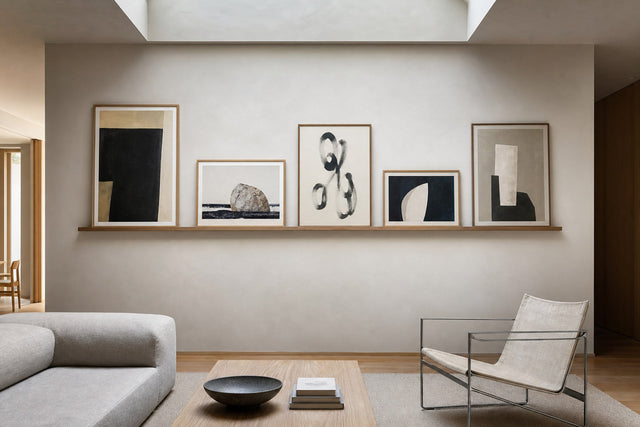
Some of the best-looking walls ignore the numbers on purpose. Leaning a framed print on a sideboard, a mantel, or even the floor skips hanging height entirely and looks deliberately relaxed — a natural home for large 70 × 100 cm pieces you may want to move around with the seasons. Floor-to-ceiling salon hangs break the rule by design: when a whole wall becomes one composition, center your favorite piece at 145–160 cm and let the rest radiate outward until the wall is full. Picture ledges put the decision on a shelf instead of in the plaster, which makes rotating art effortless. And in a child's room, hang art at the child's eye level — often 100–120 cm — because the rule was never really about a number; it was always about meeting the viewer's gaze.
Frequently asked questions
How high should you hang pictures on a wall? Hang them so the center of the artwork sits 145–160 cm above the floor, which places the image at average standing eye level. Measure to the center, not the top of the frame — measuring to the top is the main reason art ends up too high.
How high should art hang above a sofa? Leave 15–25 cm between the sofa back and the bottom of the frame, and let that gap override the eye-level rule. Choose art or a grouping about two-thirds the width of the sofa so the pairing feels balanced rather than lost.
Should all pictures in a house be hung at the same height? Aim for the same center height — not the same top or bottom edge — on open walls throughout your home; it creates a calm visual line from room to room. Furniture exceptions such as sofas, headboards, and sideboards always take priority over that shared number.
Do you hang pictures higher in rooms with high ceilings? No. Eye level does not rise with the ceiling, so the 145–160 cm center still applies. If the wall feels empty above the art, solve it with a larger piece or a taller arrangement rather than by lifting a small frame into the void.
How high should a gallery wall be hung? Treat the entire cluster as one artwork and place the center of the whole arrangement at 145–160 cm. Keep the gaps between frames consistent — 5–7 cm suits most walls — and plan the layout on paper or on screen before you drill.
Once the numbers are on your side, the only hard part left is choosing the art. Start with our bestselling posters — printed on premium 200 or 230 gsm paper, with matching wooden frames in 14 colors and 13 sizes, and 100-day returns to take the pressure off the decision.
Build your wall virtually before you spend a penny
Arrange sizes and layout on a virtual wall — free, before you buy.

Start with these
See the whole collection →


Related inspiration


100-day returns