


Homework Corner: A Calm Back-to-School Setup
A practical back-to-school guide to setting up a homework corner: where to place the desk, how high to hang wall art for a seated child, which motifs suit each age, and how to keep the wall calm all year.
The week before school starts has a rhythm of its own: name labels, new shoes, and the quiet realization that the kitchen table cannot be mission control for another year. If you are setting up a homework corner this August, the good news is that it takes one afternoon and a handful of decisions made in the right order. The desk and chair get all the attention, but the wall behind them does more of the work than most parents expect — it is what your child looks at forty times an hour while thinking.
This guide walks through the whole setup the practical way: where to put the desk, how high to hang art for a seated viewer, which motifs suit which ages, and how to keep the wall calm once the school year starts producing drawings, timetables, and gold-star spelling tests. None of it requires a room makeover. One or two well-chosen prints, hung at the right height, change how the corner feels more than any piece of furniture will.
Why the Wall Behind the Desk Does Half the Work
Watch a child do homework for ten minutes and you will notice how often they look up. Every time a sentence stalls or a sum needs holding in the head, the eyes lift off the page and land on whatever is directly ahead. That glance is part of thinking — but what the eyes land on matters. A wall crowded with stickers, busy posters, and old party invitations gives a wandering mind a dozen exits. A calm wall with one or two quiet artworks gives it a place to rest, then return to the page.
You are not decorating for visitors; you are designing the view your child will see hundreds of times a week. The goal is not blankness — a bare wall feels institutional — but a deliberate, low-stimulation view: soft colours, simple compositions, and generous empty space around each frame.
Where a Homework Corner Actually Works
Before hanging anything, get the desk position right, because it decides which wall you are styling. The classic mistake is pushing the desk under the window: it means glare on paper and screens, plus a live feed of every passing dog and delivery van. Better to place the desk against a solid wall with the window to the side, so daylight falls across the work surface without competing for attention.
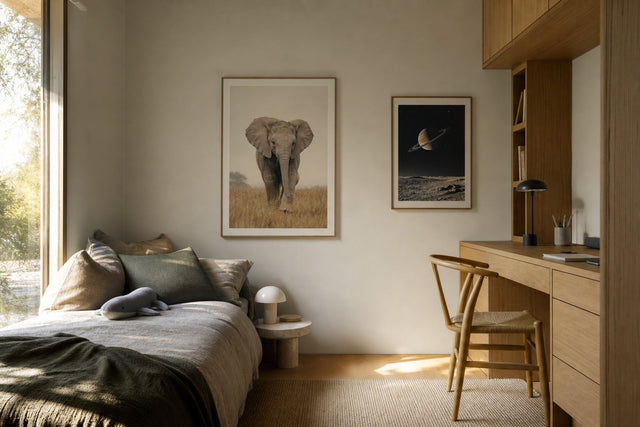
Age changes the right room. Children in the early school years usually concentrate better near a parent, so a nook off the kitchen or a corner of the living room often beats a lonely bedroom desk. From around age ten or eleven, most kids want — and handle — a desk in their own room. Either way, facing the desk toward the wall cuts distraction and gives you a contained surface for art: the desk’s width, roughly 100 to 120 cm, is your canvas.
Hang Art at Seated Eye Height, Not Standing Height
The standard hanging rule of 145 to 155 cm to the centre of the artwork is written for adults standing in a hallway. A child sitting at a desk has a far lower eye level, so art hung at gallery height floats above their world and does nothing for the seated view.
- Measure seated eye level first. Sit your child in the desk chair and measure floor to eyes — for most 6- to 12-year-olds this lands between 100 and 115 cm.
- Centre the print near that height. With a standard 72 cm desk, that usually means the bottom edge of the frame sits 15 to 20 cm above the desktop.
- 30x40 cm is the sweet spot. One 30x40 print in portrait suits a narrow desk; two of them side by side with a 5 to 8 cm gap fill a 120 cm desk beautifully. Save 50x70 cm and larger for open walls elsewhere in the room.
- Level with the desk, not the ceiling. Align the pair’s bottom edges parallel with the desktop — the eye reads that line instantly and the corner looks intentional.
If you are nervous about nail holes, the free Gallery Wall Builder lets you arrange sizes and pairings on a virtual wall before you commit to a single hole in the plaster.
Ages Five to Nine: Friendly Faces, Soft Colours
For the youngest school children, the best desk-wall art is warm, figurative, and simple. Friendly animal motifs are the reliable choice: a single fox, a bear, or a soft-edged rabbit illustration gives the child something to like without a story to disappear into. Look for one clear subject and plenty of quiet background — a portrait of one animal beats a busy jungle scene at the desk. You will find both in a good animal poster collection; hang the calm ones in the sightline and the lively ones behind the child.
One honest caution: alphabet charts, world maps, and multiplication posters are tools, not art. They earn a place near the desk — on or beside the pinboard — but not as the framed centrepiece. An alphabet in a frame signals that the wall is just another worksheet.
Tweens and Teens: Calm Illustration and Words That Earn Their Place
From around age ten, taste arrives — and the wall should reflect it, within calm limits. Muted line art, simple botanical prints, soft abstract shapes, and quiet landscape illustrations all work well: grown-up enough to feel respected, restrained enough to sit in a sightline for two hours of homework.
Quote prints deserve a special note, because words in the sightline get read on every glance — a well-chosen quote is quietly powerful, a badly chosen one exhausting. Two rules keep it right: the child picks the words, and there is only ever one quote print at the desk. A short, steady phrase in clean typography — browse quote posters together and let them shortlist — will still feel true in June. A joke or a shouty slogan will not survive September.
The Visual-Noise Rule: Two Artworks in the Sightline, No More
If you take one rule from this article, take this one: a maximum of two artworks in the child’s seated sightline. The sightline is the arc of wall the child sees when they lift their eyes from the page without turning their head — roughly the width of the desk plus a hand-span either side, from desktop height to about 40 cm above their head. Inside that arc: one or two framed prints. Everything else — the pinboard, shelves, the growing rosette collection — lives outside it.
The test is simple and slightly humbling: sit in your child’s chair, at their height, and look up from an imaginary worksheet. Most parents who try this discover the “inspiring” wall they built contains eleven objects. Prune it to two and the corner feels quieter at once — children notice, even if they cannot say why.
The Pinboard-Plus-Frame Combo That Beats Wall Clutter
A school year produces paper the way autumn produces leaves, and the homework corner is where it all wants to land. The fix is a strict division of labour: one pinboard for everything that rotates, one or two frames for the art that stays.
- Hang the pinboard beside the desk, not behind it. A 40x60 or 45x60 cm cork or felt board on the side wall keeps timetables and reading logs within reach but out of the direct sightline.
- Paper goes on the board; art stays in frames. No taping drawings to the wall, no wedging certificates behind the frame — the rule sticks because it is absolute.
- Full board means something comes down. When there is no free cork left, the oldest item is retired to a memory box, so the board never creeps across the wall.
- Promote the best work properly. Once or twice a term, the drawing your child is proudest of graduates into a real frame — wooden frames come in 14 colours and 13 sizes, so a child’s masterpiece hangs in the same quality frame as the prints beside it. Being framed becomes an honour.
Colour Pairings That Help a Child Settle
Colour does quiet work in a homework corner. You do not need a repaint — the prints themselves can carry the palette — but choose it deliberately. Muted, slightly greyed tones settle a room; saturated primaries wake it up. Save the brightness for the play zone.
- Dusty blue + sand + white: cool and steadying, flattering next to white and pine desks — the safest all-round palette for a first homework corner.
- Sage green + warm grey: calm with a natural feel; pairs beautifully with oak furniture and botanical or animal motifs.
- Cream base + one terracotta accent: warmth without noise — keep the terracotta to a single element so it stays an accent, not a shout.
- Soft grey-blue + muted mustard: a slightly older, tween-friendly pairing that works well with black or white frames.
- What to avoid at the desk: high-saturation red and rainbow-everything walls. Wonderful in a playroom, counterproductive 30 cm from a maths worksheet.
Match the frame to the palette rather than the furniture: light oak or white frames keep cool palettes airy, while a black frame gives a tween’s corner a touch of seriousness they usually appreciate.
FAQ: Homework Corners and Kids’ Wall Art
How high should I hang pictures above a child’s desk?
Hang them for a seated viewer, not a standing adult. Measure your child’s eye level while seated — typically 100 to 115 cm from the floor — and centre the artwork near that height. In practice, the bottom edge of the frame usually sits 15 to 20 cm above the desktop.
What size poster is best for a homework corner?
30x40 cm is the most versatile size: large enough to read as real art, small enough not to loom over a child. Use one 30x40 print above a narrow desk, or a pair with a 5 to 8 cm gap above a 120 cm desk.
What kind of wall art helps kids concentrate?
Simple, low-stimulation motifs in muted colours: a single friendly animal for younger children, and calm illustration, botanicals, or one well-chosen quote print for tweens and teens. Composition matters as much as subject — one clear focal point and plenty of quiet space beats a busy scene every time.
Where should a homework station go in a small home?
Choose a wall, not a window: a solid wall with side-on daylight beats a desk under the window for both glare and distraction. For younger children, a corner of the kitchen or living room near a parent often works better than a bedroom. Even a 100 cm stretch of wall is enough for a desk, a 30x40 print, and a side-mounted pinboard.
How do I display schoolwork without cluttering the wall?
Use the pinboard-plus-frame system: all rotating paper goes on one pinboard beside the desk, and only framed art hangs on the wall itself. When the board is full, the oldest piece moves to a memory box. The best work of the term gets promoted into a real frame — display stays an honour, and the wall stays calm.
A homework corner does not need to be finished by the first school morning — it needs a good desk position, one or two calm prints at seated eye height, and a system for the paper to come. Start with the wall, and the rest of the routine has somewhere to live. When you are ready to choose the prints, explore the kids and youth poster collection and pick one or two that will still feel calm in June.
Build your wall virtually before you spend a penny
Arrange sizes and layout on a virtual wall — free, before you buy.

Start with these
See the whole collection →


Related inspiration
100-day returns